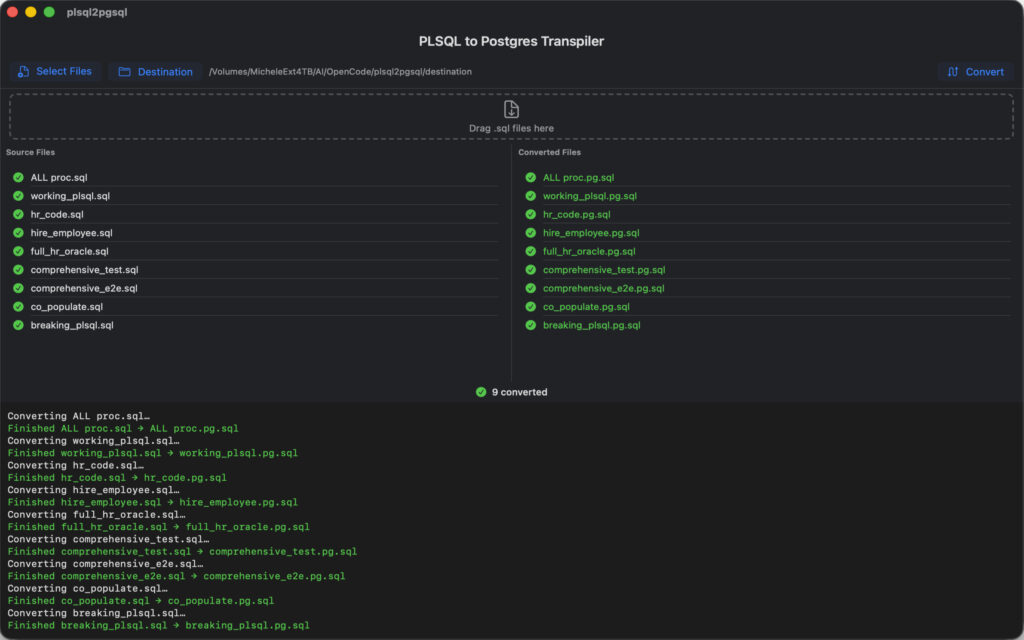
PLSQL2PGSQL — Oracle-to-PostgreSQL Transpiler for macOS, Linux, Windows (macOS native app shown)
Overview
PLSQL2PGSQL is a cross‑platform Oracle PL/SQL transpiler that parses source files using ANTLR4 and emits semantically equivalent PostgreSQL PL/pgSQL (or PL/Python3u). It handles a broad range of Oracle constructs — functions, procedures, packages, triggers, types, collections, bulk operations, dynamic SQL, exception handling, transaction control, and DDL — across both single‑file and batch workflows.
Available as a lightweight CLI, a cross‑platform Wails desktop GUI, a native macOS SwiftUI app, a Windows WPF .NET app, and Linux .deb / .rpm packages.
 Linux binary + .deb/.rpm
 Windows WPF app + installer
 CLI for scripting / CI
Parser Architecture
- ANTLR4‑based parsing using the Oracle PL/SQL grammar targeting the Go runtime, actually one grammar for PLSQL and one grammar for DDL
- Dual prediction mode: SLL (fast‑path) for typical constructs, with automatic fallback to LL (full context) when SLL produces degraded output — detected via heuristics on dollar‑quoted body completeness, missing
END;, unconverted Oracle keywords, and bare‑identifier IF conditions - Error recovery: token recognition errors and syntax errors are captured per‑file and displayed in the UI, clearly marking files that need manual review
- Regex pre‑/post‑processing for constructs the grammar cannot parse directly — SQL*Plus, GRANT/REVOKE, CONNECT BY, RETURN arithmetic, and body‑loss fallback
- Parser‑level SQL*Plus handling:
SET,SPOOL,PROMPT,DEFINE,UNDEFINE,COLUMN,BREAK,COMPUTE, REPHEADER,REPFOOTER,ACCEPT,EXECUTE,START,@,@@,/(slash execute),WHENEVER- — all converted at the pre‑parser level before ANTLR invocation
Language Translations
Data Type Mappings
VARCHAR2(n)→VARCHAR(n)NUMBER(p,s)→NUMERIC(p,s); bareNUMBER→NUMERICDATE→DATECLOB→TEXTBLOB→BYTEAPLS_INTEGER,BINARY_INTEGER→INTEGERRAW(n)→BYTEATIMESTAMP WITH TIME ZONE→TIMESTAMPTZ%TYPE,%ROWTYPE→ resolved to the target column’s PostgreSQL type at transpile time (default:TEXT/RECORD)
Functions & Control Flow
NVL→COALESCEDECODE→CASELISTAGG→STRING_AGGINSTR→STRPOSSYSDATE→now()ADD_MONTHS,MONTHS_BETWEEN,NEXT_DAY,LAST_DAY— date arithmetic equivalentsTO_CHAR/TO_DATE/TO_NUMBER— type cast conversions with format‑model stripping where a PostgreSQL equivalent existsNVL2,NULLIF,COALESCE,SYS_GUID,UID,USER,USERENV,RAISE_APPLICATION_ERRORDETERMINISTIC→IMMUTABLEPIPELINED→RETURNS TABLEIF/ELSIF/ELSE,CASE, all loop types (FOR,WHILE,LOOP,FORALL),EXIT,CONTINUE,GOTOCONNECT BY PRIOR→WITH RECURSIVECTECONNECT BY LEVEL→generate_series()
Packages
- Package specs decomposed into individual function/procedure stubs
- Package bodies decomposed into standalone
CREATE FUNCTION/CREATE PROCEDURE - Package variables mapped to GUC getter/setter pairs (
set_config/current_setting) TYPE BODYmember functions → standalone functions withMEMBER→selfparameter mapping,STATICpreserved as‑is
Triggers
- DML triggers (
BEFORE,AFTER,INSTEAD OF) → trigger function +CREATE TRIGGERDDL COMPOUND TRIGGERdecomposed into per‑timing‑point functionsALTER TRIGGERENABLE/DISABLE→ALTER TABLE … ENABLE/DISABLE TRIGGER- Non‑DML triggers (
ON SCHEMA,ON DATABASE) →CREATE EVENT TRIGGER - Cross‑unit trigger table resolution:
CREATE TRIGGERin earlier files populates a table map forALTER TRIGGERin later files
Collections & Records
TABLE OF/VARRAYtype declarations in standaloneCREATE TYPE- Anonymous‑block
RECORD/TABLE/VARRAYdeclarations .COUNT,.FIRST,.LAST,.EXISTS,.DELETE(key),.DELETE(),-
.EXTEND(n),.EXTEND(n,i),.TRIM,.TRIM(n) DECLARE‑sectionRECORDaliases →RECORD‑typed variables
Dynamic SQL
EXECUTE IMMEDIATE→EXECUTEwithUSING IN/OUTclauseRETURNING INTOinjected inside the SQL string (PostgreSQL requirement)
Bulk Operations
FORALL i IN 1..n→FORloop with array iterationFORALL INDICES OF/VALUES OF→ recognised; emits TODO comment (requires manual porting — Oracle’s associative‑array semantics have no direct PL/pgSQL analogue)BULK COLLECT INTO→ stripped (PostgreSQL uses plainSELECT INTO)
Exception Handling
- Named Oracle exceptions mapped to PG equivalents:
NO_DATA_FOUND,TOO_MANY_ROWS,ZERO_DIVIDE→DIVISION_BY_ZERO, -
DUP_VAL_ON_INDEX→UNIQUE_VIOLATION,VALUE_ERROR→DATA_EXCEPTION, and others OTHERShandler →WHEN OTHERS THEN- Custom exception declarations →
DECLARE+RAISE PRAGMA EXCEPTION_INIT→ customSQLSTATE 'Uxxxx'PRAGMA AUTONOMOUS_TRANSACTION→ dblink‑wrapped autonomous execution blockPRAGMA SERIALLY_REUSABLE→ comment with suggestion
XML Functions
Most XML functions are implemented as pure PL/pgSQL helper functions in xml_plpg.go. Unicode composition/decomposition (COMPOSE, DECOMPOSE) use PL/Python3u with Python stdlib unicodedata.normalize().
XMLELEMENT,XMLFOREST,XMLAGG,XMLTABLE,XMLPARSE,XMLSERIALIZE,XMLTYPEEXISTSNODE,EXTRACTVALUE,XMLCONCAT,XMLCDATA,XMLCOMMENT,XMLPI,XMLROOTXMLISVALID,XMLSEQUENCE,XMLCAST,XMLQUERYUPDATEXML,DELETEXML,INSERTCHILDXML,APPENDCHILDXML,INSERTXMLBEFOREXMLTRANSFORM→xslt_process()viaxml2C extension
DDL Handling
CREATE TABLE— type mapping, inline defaults, constraints, identity columns (NUMBER IDENTITY→BIGINT IDENTITY)ALTER TABLE—MOVE TABLESPACE→SET TABLESPACE, partition handlingCREATE SEQUENCE— Oracle→PG syntax adaptationCREATE SYNONYM→CREATE VIEWwrapperCREATE TABLESPACE→ PG tablespace with/tmp/fallback pathCREATE INDEX—BITMAP→ B‑tree with commentGRANT/REVOKE— Oracle‑to‑PostgreSQL system and object privilege mapping (14 system privileges + object grants)CREATE DATABASE LINK→ FDWCREATE SERVER+USER MAPPING- External tables (
ORGANIZATION EXTERNAL … ORACLE_LOADER) →file_fdwforeign tables with automatic server creation and deduplication
System View Mapping
Oracle system views replaced with PostgreSQL catalog equivalents:
| Oracle View | PostgreSQL Equivalent |
|---|---|
ALL_TABLES |
information_schema.tables |
ALL_TAB_COLUMNS |
information_schema.columns |
ALL_CONSTRAINTS |
information_schema.table_constraints + pg_constraint |
ALL_CONS_COLUMNS |
information_schema.constraint_column_usage |
ALL_INDEXES |
pg_indexes |
ALL_VIEWS |
information_schema.views |
ALL_SOURCE |
pg_proc / information_schema.routines |
ALL_TRIGGERS |
pg_trigger |
ALL_USERS |
pg_roles |
ALL_OBJECTS |
pg_class + pg_proc + pg_type |
ALL_DEPENDENCIES |
pg_depend |
ALL_IND_COLUMNS |
pg_index — indkey::int2vector |
DBA_TAB_PRIVS |
information_schema.table_privileges |
DBA_ROLE_PRIVS |
information_schema.applicable_roles |
V$SESSION |
pg_stat_activity |
V$PROCESS |
pg_stat_activity — backend_start, state |
V$SQL |
pg_stat_statements (if extension installed) |
V$LOCK |
pg_locks |
DBA_TAB_STATISTICS |
pg_stats / pg_class |
SESSION_PRIVS |
information_schema.enabled_roles |
Note: ALL_SEQUENCES, ALL_TAB_PRIVS, ALL_COL_COMMENTS, ALL_TAB_COMMENTS, ALL_SYNONYMS, USER_TABLES, USER_OBJECTS, V$PARAMETER, DBA_DATA_FILES and DBA_FREE_SPACE are recognised but not yet mapped — they pass through unchanged for manual replacement.
Helper Function Pattern
Oracle functions without a direct PostgreSQL built‑in are implemented as auto‑generated CREATE FUNCTIONhelpers. The transpiler emits both the translated call and the helper DDL in the output.
JULIAN→ julian‑to‑date conversionREGEXP_INSTR→ regex position searchSCN_TO_TIMESTAMP→pg_xact_commit_timestamp(xid)INTEGER_TO_WORDS→ JSP‑format number spellingCOMPOSE,DECOMPOSE→ PL/Python3uunicodedata.normalize()UNISTR,ASCIISTR→ Unicode escape/unescape- XML helpers (UPDATEXML, DELETEXML, INSERTCHILDXML, etc.)
Distribution
Available Now
- CLI binary — Go cross‑compiled executable for macOS (arm64+amd64), Linux (arm64+amd64), Windows (amd64). Ideal for scripting and CI/CD. (It is ready, coming soon to distribution)
- Wails desktop GUI — cross‑platform native window (macOS, Windows, Linux)
- Windows WPF .NET app — full Windows desktop experience with Inno Setup installer
- Linux .deb / .rpm — for Debian/Ubuntu and Fedora/RHEL
Just Released
- Mac App Store — sandboxed, code‑signed, hardened runtime, macOS 14.0+ https://apps.apple.com/us/app/plsql2pgsql/id6785566298?mt=12&itscg=30200&itsct=apps_box_link&mttnsubad=6785566298
Technical Details
- Language: Go (ANTLR4 runtime), roughly 15000 Lines of Go code
- Parser: ANTLR4 Oracle PL/SQL grammar
- Output targets: PL/pgSQL, PL/Python3u
- macOS native app: SwiftUI (Xcode project) with Cgo bridge
- Windows native app: C# WPF .NET with P/Invoke to Go DLL
- Cross‑platform GUI: Wails v2 (Go backend + WebView frontend) – for Linux and Windows
- Test suite: Go test functions + Python integration runner + end‑to‑end tests against live PostgreSQL
Disclaimer: All trademarks belong to their owners.